Recently, the Pathogen Prevention and Control Research Team at GXU's College of Life Science and Technology, working with a team from the University of California, Santa Cruz, systematically reviewed the latest research advances in the structural assembly, gene expression regulation and “non-motility” functions of Helicobacter pylori flagella. The findings, titled “From Swimming to Sensing: The Multifunctional Flagella of Helicobacter,” were published in Annual Review of Microbiology, an authoritative journal in the field. Liu Xiaolin, Associate Professor at GXU's College of Life Science and Technology, and Karen M. Ottemann, Professor at the University of California, Santa Cruz, are the co-corresponding authors, and Guangxi University is a co-corresponding institution of the paper.
Helicobacter pylori infection affects about half of the world's population and is a major contributing factor to chronic gastritis, peptic ulcers and gastric cancer. The mucus layer covering the gastric mucosa is extremely viscoelastic and constitutes the first barrier that bacteria must cross in order to colonize. H. pylori propels itself with flagella that arise in a unipolar tuft and are wrapped in a membranous sheath, enabling the bacterium to penetrate the mucus layer and colonize the gastric epithelial surface; strains with defective flagella show a markedly reduced capacity to colonize. Yet compared with classical model bacteria such as Escherichia coli and Salmonella, H. pylori flagella present numerous “exceptions” in structural composition, assembly mode and regulatory logic, and have long lacked a systematic review.
The article repositions the flagellum from a purely locomotive organ to a multifunctional device that combines motility, sensing and regulation, and systematically compares the flagellar motor structures of H. pylori, E. coli and Campylobacter jejuni. Compared with the classical model, the H. pylori flagellar motor is larger and features multiple disk-like and cage-like structures in the periplasmic space that support the high-speed rotation of the motor. These structural features allow the bacterium to remain motile in gastric mucus, whose viscosity is far higher than that of water. In the regulation of flagellar gene expression, H. pylori likewise differs from the classical model. Most bacteria rely on a single master regulator to initiate the cascade expression of flagellar genes, whereas H. pylori lacks such a master regulator and instead builds a hierarchical regulatory system around two σ factors, setting checkpoints at multiple steps to ensure the orderly assembly of flagellar components in the required quantities.
In addition, H. pylori flagella perform functions beyond motility. H. pylori can form biofilms on the surface of the gastric mucosa, and the structural integrity and rotational state of the flagella are prerequisites for biofilm maturation; moreover, clockwise and counterclockwise rotation exert opposite regulatory effects on biofilm formation. This indicates that the flagellum also serves a mechanosensory function, transmitting signals into the cell and regulating the switch between motile and sessile states. Notably, this pathway does not depend on c-di-GMP, a signaling molecule ubiquitous in bacteria, suggesting that H. pylori possesses a novel signaling pathway that offers a potential target for antimicrobial drug development.
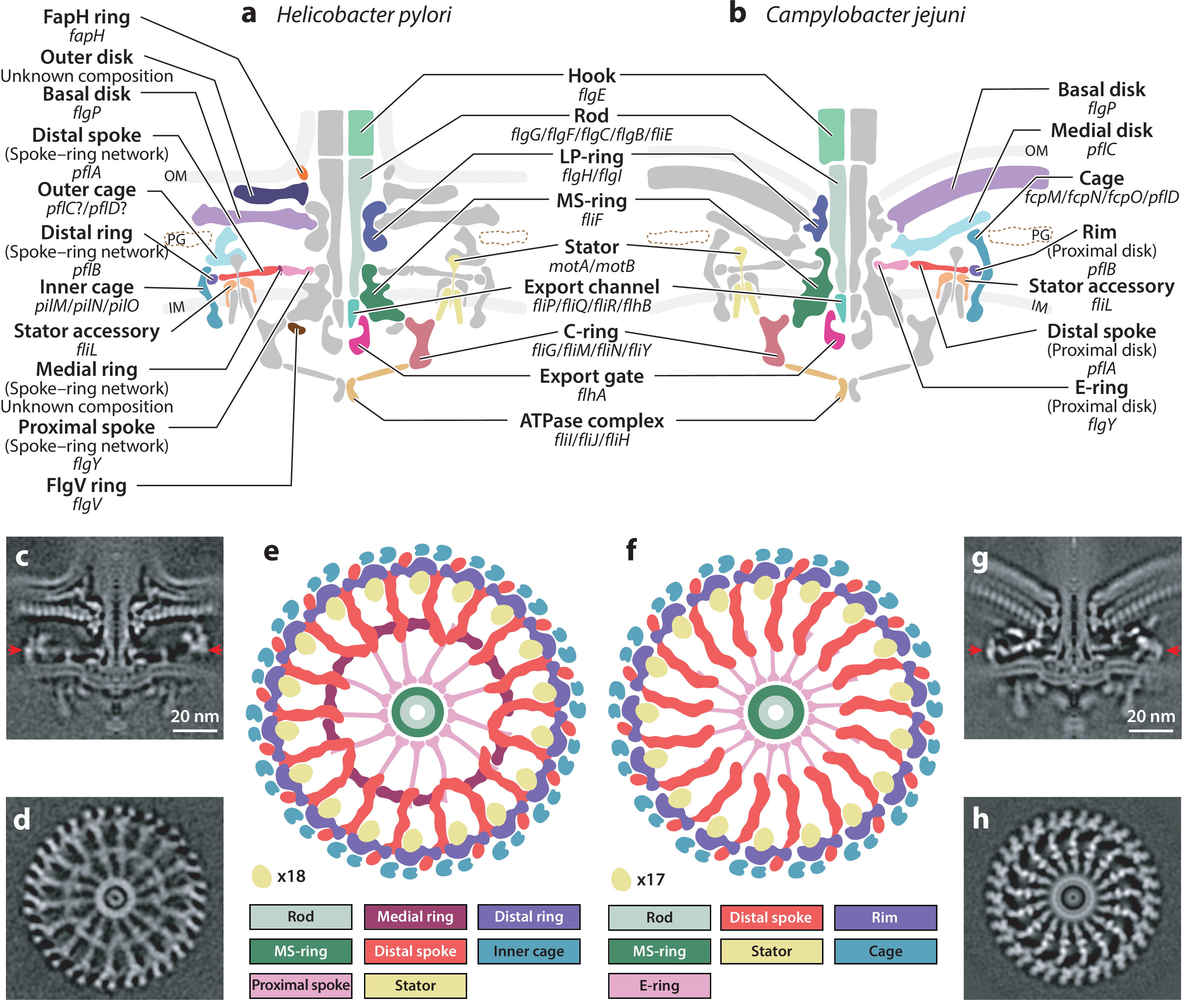
Comparison of the assembly structures of complex bacterial flagella
Integrating evidence from structural biology, genetics and physiology, the review establishes a systematic comparative framework for research on H. pylori flagellar function, offers a new perspective for understanding how pathogens adapt to extreme microenvironments, and opens up new approaches for developing antibacterial strategies that target flagellar assembly and mechanosignaling pathways.
The study was supported by the National Natural Science Foundation of China, the Guangxi Major Talent Support Program and the Guangxi Natural Science Foundation, among others.

 Home
>
News & Events
>
Events


