Recently, the Blue Energy Team at the School of Physics, Science and Engineering Technology at Guangxi University (GXU) has achieved new progress in the area of light-written nonvolatile polarization. They successfully developed a flexible PDMS-based composite material capable of being written with light and retaining the polarization state for a long time. The work, titled “Light-Written Nonvolatile Polarization via Defect-Engineered Charge Trapping,” was published in Advanced Materials. The first author is Liu Boxun, a PhD student at the School of Physics, Science and Engineering Technology; the corresponding author is Wan Lingyu, a Professor at the same School; co-corresponding authors include Liu Guanlin, Associate Professor at the School, and Li Yahui, a Postdoctoral researcher at Nanyang Technological University, Singapore.
Programmable and long-lasting interfacial polarization is a core foundation for flexible electronic systems such as triboelectric generators, electrostatic actuators, and cantilever-based devices. Traditional polymer electret polarization relies on high-voltage poling processes, while ferroelectric materials are limited by the mechanical rigidity of ceramic substrates. Light, as a noninvasive, spatially localized, and rapidly switchable stimulus, offers an ideal route for polarization control. However, in polymer systems, photoexcited charges tend to recombine and decay rapidly, a bottleneck that has persisted.
To address the challenge of maintaining photoinduced polarization in soft composite systems, the team proposed a defect-engineering strategy to tailor trap states at the polymer–oxide interface. They achieved highly retainable light-induced polarization by engineering defects. They used titanium ferrite (FeTiO3, FTO) nanoparticles, and employed spark plasma sintering (SPS) to effectively increase oxygen vacancy-related defect density. After SPS treatment, FTO was incorporated into polydimethylsiloxane (PDMS) to form a composite film. Under illumination, photoexcited electrons reduce the interfacial barrier at the metal–composite interface, promoting charge transfer and accumulation; once illumination is removed, most photoexcited electrons are captured by oxygen vacancy traps, generating persistent residual polarization. Experiments show that after illumination is removed, SPS-treated samples retain about 81% of the photo-induced charge contribution, while untreated samples retain only about 33%. Kelvin probe force microscopy (KPFM) directly visualizes the long-term stability of the polarization retention. This work demonstrates defect-engineered light programming and long-retaining polarization in soft composites, offering a solution for remotely addressable electrostatic interfaces in flexible electronic systems.
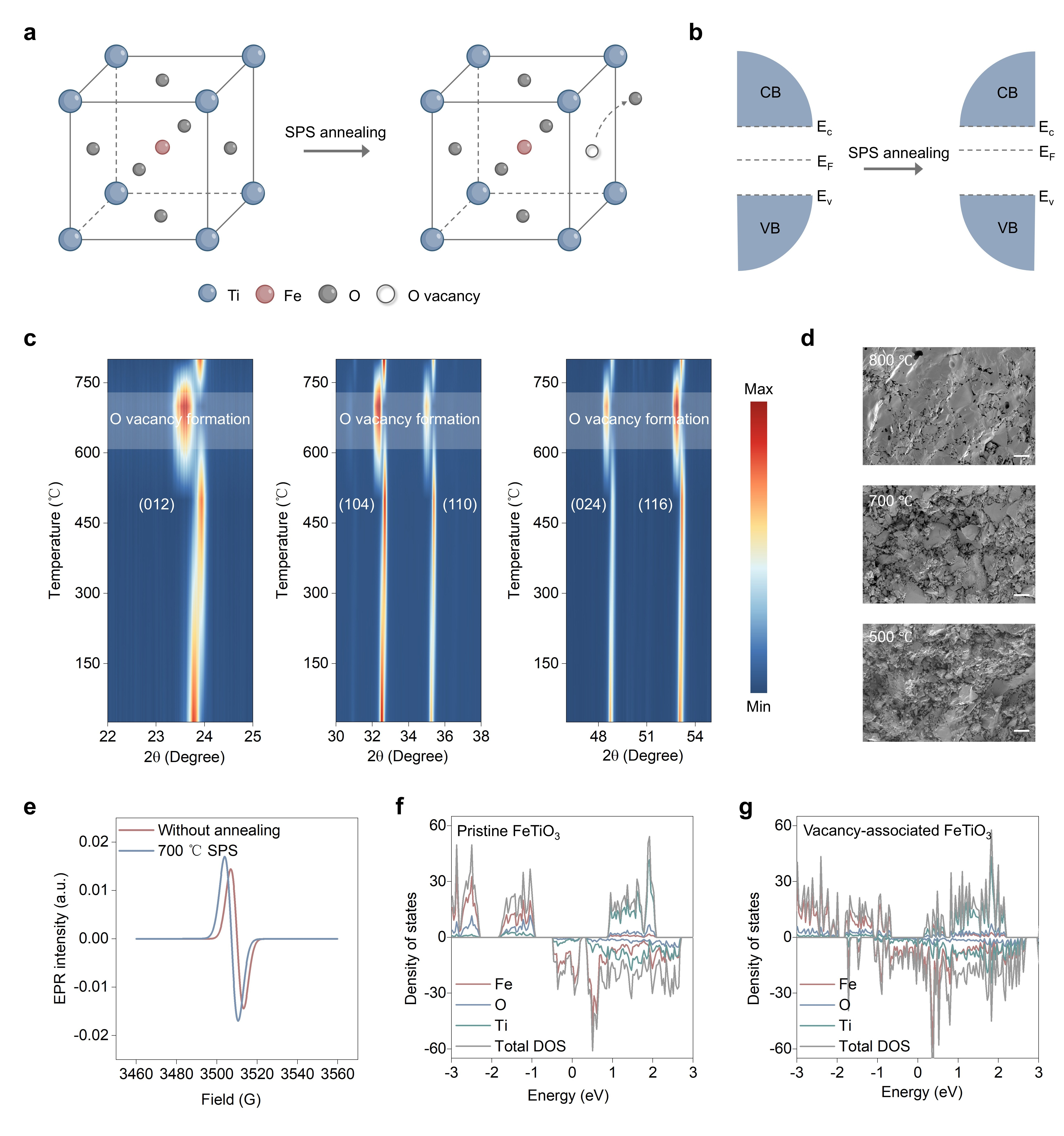
Figure. Defect engineering modulation of oxygen vacancies and electronic structure evolution
The work was supported by the National Key R&D Program, the Guangxi Zhuang Autonomous Region Talent Program, and the Beijing Key Laboratory of High-Entropy Energy Materials and Devices, among others.

 Address: No.100,East Daxue Road,Xixiangtang District,Nanning, Guangxi,China
 Postal Code: 530004
 Tel: 86-771-3238863
 Email: gjc@gxu.edu.cn